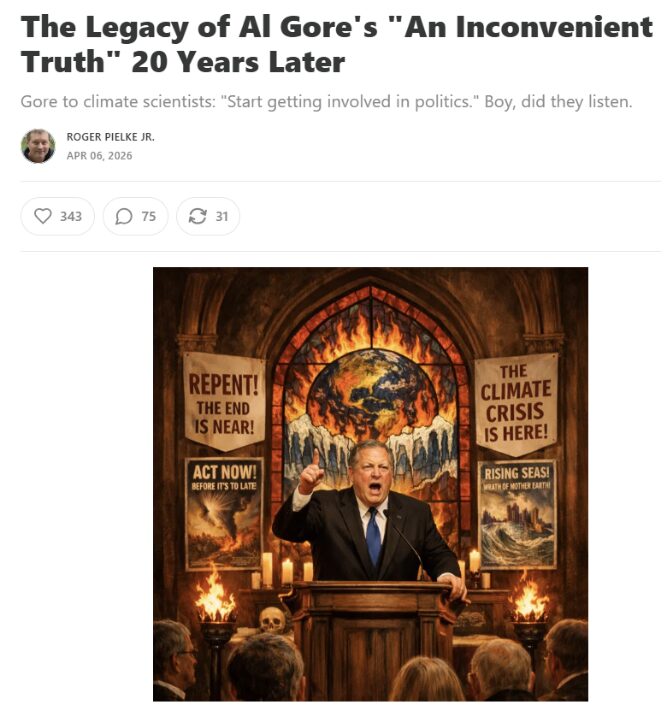
Al Gore’s An Inconvenient Truth, came out 20 years ago next month and stirred a global panic. It also won him a Nobel prize.
The film’s appeal stemmed in part from its oft-repeated apocalyptic predictions about what would happen to Planet Earth if governments didn’t act to curb carbon dioxide emissions.
Africa’s Kilimanjaro would lose its snow within a decade. Didn’t happen.
Glacier National Park in Montana would lose its glaciers by 2020. Nope.
Greenland’s ice sheet was portrayed as being on the brink of collapse. In recent years, we’ve seen some of its lowest net ice loss thanks to heavier snowfall and lower melt.
Gore also predicted global sea levels would rise by as much as 236 inches “in the near future.” In truth, per NOAA, sea levels rose by just 3.8 inches from 1993 and 2021 – an error of some 95%.
What did happen as a result of these kinds of baseless scare tactics is that energy became much more expensive, stunting economic growth and impoverishing poor people.
The world became poorer but Al Gore’s net worth sky-rocketed to an estimated $300 million. Selling doomsday is a very lucrative endeavor.