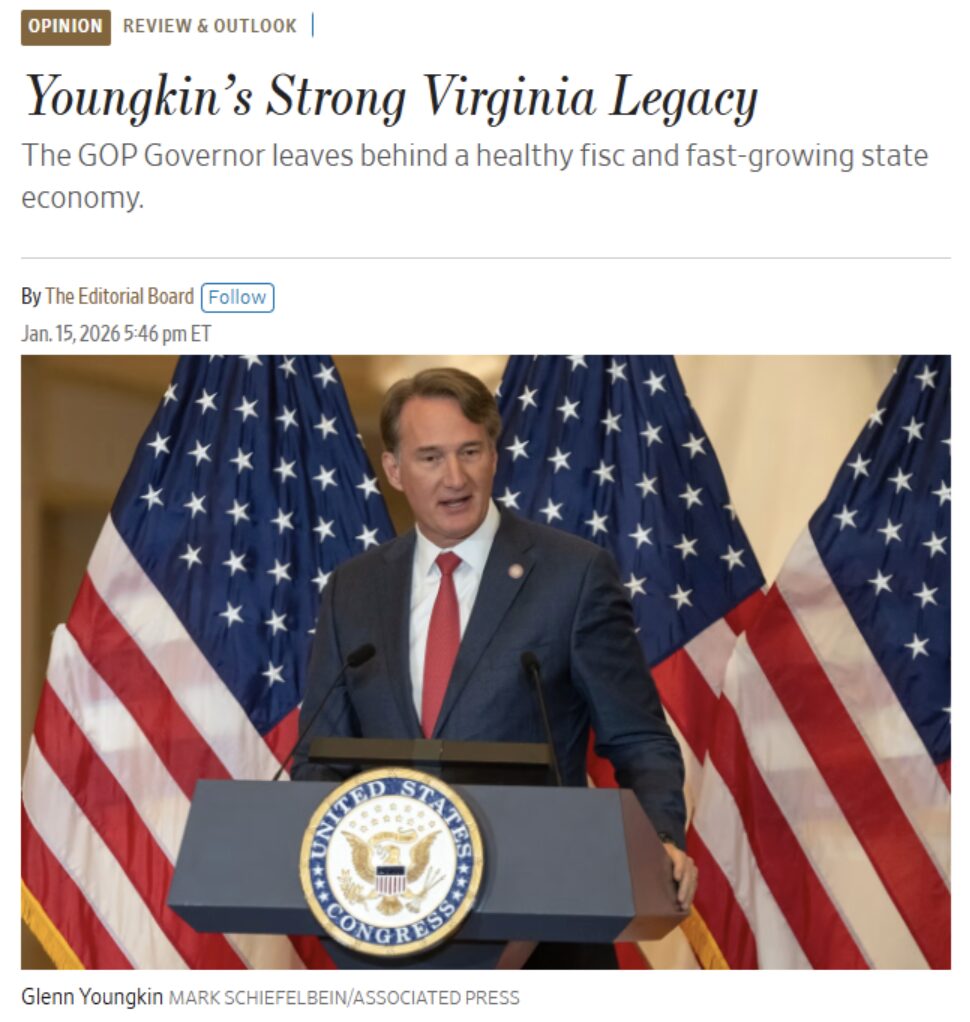
Virginia’s Glenn Youngkin leaves office on Saturday, capping one of the most successful single terms of any governor in recent memory.
Virginia is a light blue state, whose pro-growth and pro-business tax and regulatory policies brought prosperity back to the Old Dominion state. In UP’s “Vote With Your Feet” report, Virginia turned around a decline. Youngkin told a UP gathering last summer that “for the first time in 10 years, more people moved to Virginia than moved away to the other 49 states, Common sense works.”

What is perhaps most remarkable is that Democrats controlled at least one house of the legislature during his term, blocking his boldest proposals. Nonetheless, he accomplished a lot. The state’s unemployment rate is 3.5%, compared to 4.4% nationally. He cut taxes by $9 billion, including the state’s hated grocery tax. He eliminated some 90,000 regulations.
That helps explain Virginia’s No. 1 ranking on CNBC’s list of “Top States for Business” in 2024. It dipped slightly last year, which left Democratic State Senate Leader Louise Lucas to complain that was only because the state’s federal workers were “crushed by Trump’s policies and reckless federal cuts.”
On education, he ended COVID-era mandates, decreased chronic absenteeism and ended Critical Race Theory in schools. He won his election on the theme of letting parents have more control of the schools.
On energy, he dropped out of the Regional Greenhouse Gas Initiative and ended the Virginia Clean Economy Act. Virginia is now called the data center capital of the world.
On crime, Youngkin presided over a 59% reduction in fatal fentanyl overdoses and a 30% drop in murder.
Youngkin has proven he can win moderate Democratic voters – albeit a pool that is alas shrinking.
Conservatives could do a lot worse than Youngkin in 2028 – and sometimes we fear that they will.
We recommend this WSJ editorial on Youngkin.