

We consulted with one of the popular AI platforms and asked whether the Laffer Curve is real or not. Here is the answer we received.
We think we will give Claude a B grade on this economic test:

Prompt:
Is there a Laffer Curve?
Partly yes, partly no.
Arthur Laffer’s core insight has been proven correct: there is some tax rate at which higher taxes begin to reduce tax revenue because people change their behavior, work less, invest less, shift income, or avoid taxes. Economists across the political spectrum generally accept that a “Laffer Curve” exists in principle.
What Laffer got right
- At a 0% tax rate, government revenue is zero.
- At a 100% tax rate, revenue would also tend toward zero because there would be little incentive to earn taxable income.
- Therefore, some revenue-maximizing rate must exist between those extremes.
This basic concept is widely accepted in public finance and economics auditing accounting.
Where the debate lies
During the Reagan era, some advocates argued that U.S. tax rates were so high that cutting them would largely or completely pay for themselves through faster growth and higher taxable income.
Most empirical research since then has found:
- Tax cuts can boost economic activity to some extent.
- Tax cuts recover some of the lost revenue through growth.
- But tax cuts usually do not recover all of the lost revenue, particularly when starting tax rates are already moderate rather than extremely high.
Bottom line
If the question is”Was Laffer correct that excessively high tax rates can reduce revenue?”, the answer is yes, and that is broadly accepted economic theory.
If the question is: Was Laffer correct that major U.S. tax cuts would generally pay for themselves through higher growth?“, the evidence is much weaker. The mainstream view is that tax cuts may offset part of their revenue cost, but generally not all of it.
So historically, economists tend to conclude that the Laffer Curve is real, but supply-side advocates often overestimated how close the United States was to the revenue-maximizing tax rate.
Claude also generated this graphic for this item specifically.
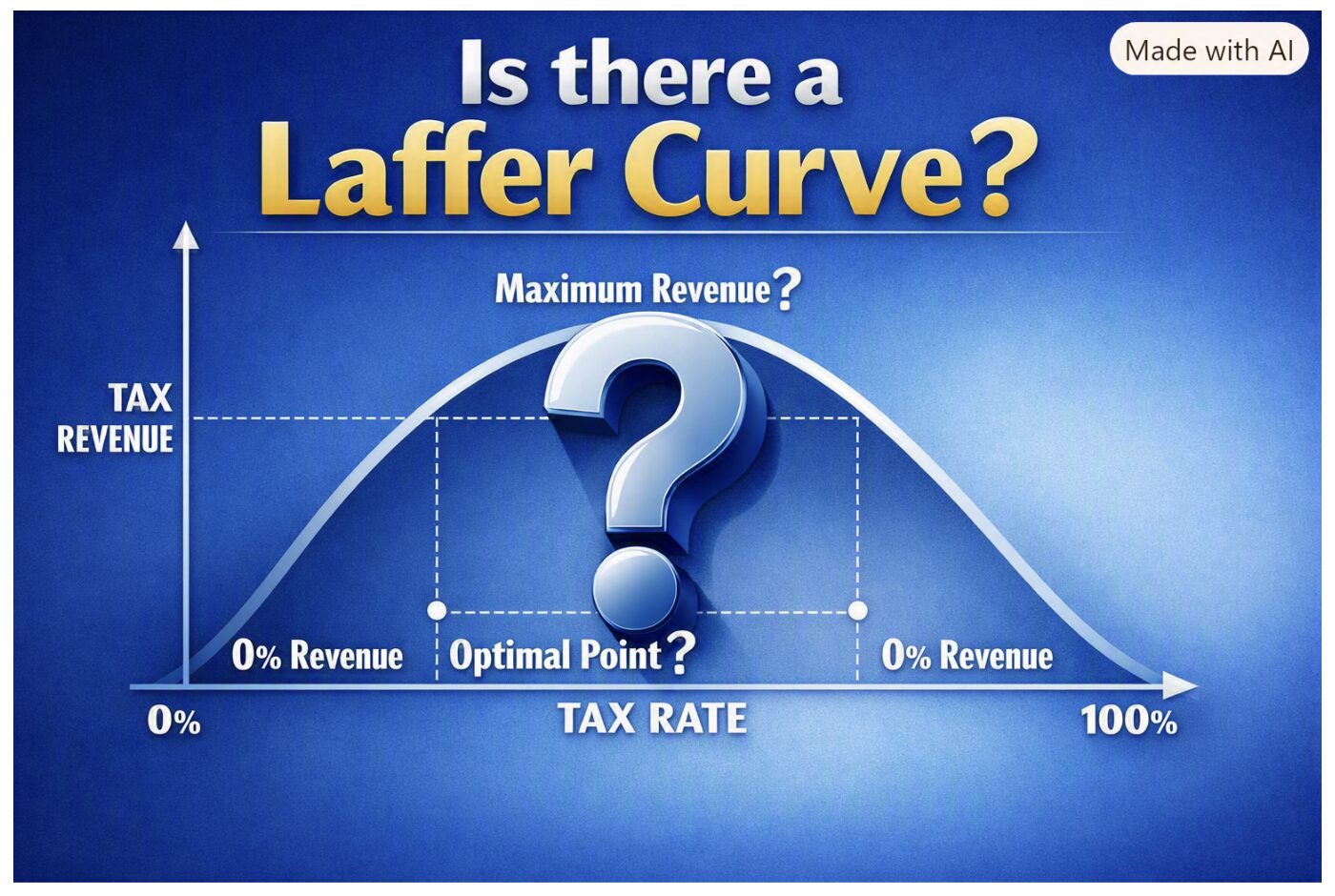
What do you think?
One important nuanced point that AI got wrong: because cutting tax rates increases work and investment, the total tax take of the government often rises even though revenues from the specific tax that has been cut will fall. That happened in the 1980s after the Reagan tax cuts and after the Trump tax cuts.