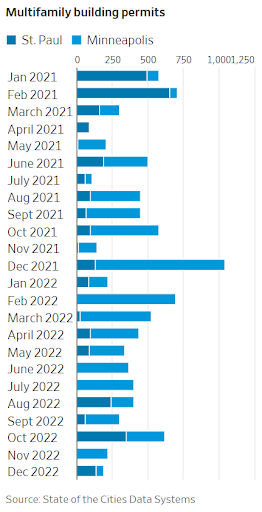
The WSJ reports on a natural experiment in rent control in the twin cities of Minnesota, where St. Paul enacted rent control laws. They capped annual increases at 3%, while Minneapolis went the other way and streamlined permitting to encourage new construction.
In 2022, St. Paul enacted one of the strictest rent-control regimes in the country. The ordinance capped annual rent increases at 3% for most apartments, even empty ones. It didn’t adjust for inflation.
Across the Mississippi River, Minneapolis steered clear of rent control. Instead, city officials strictly focused on creating new housing. A package of land-use revisions in 2020 made it easier to build apartments, in part by removing restrictions that limited housing to single-family homes.
The result:
Permits to build apartments in St. Paul plummeted by 79% in early 2022 from the year before, according to data from the Department of Housing and Urban Development. Real-estate investment activity nearly froze. Developers halted new projects as lenders pulled back…
St. Paul officials are now walking back parts of the ordinance, voting in May to exempt new construction and properties built after 2004.