

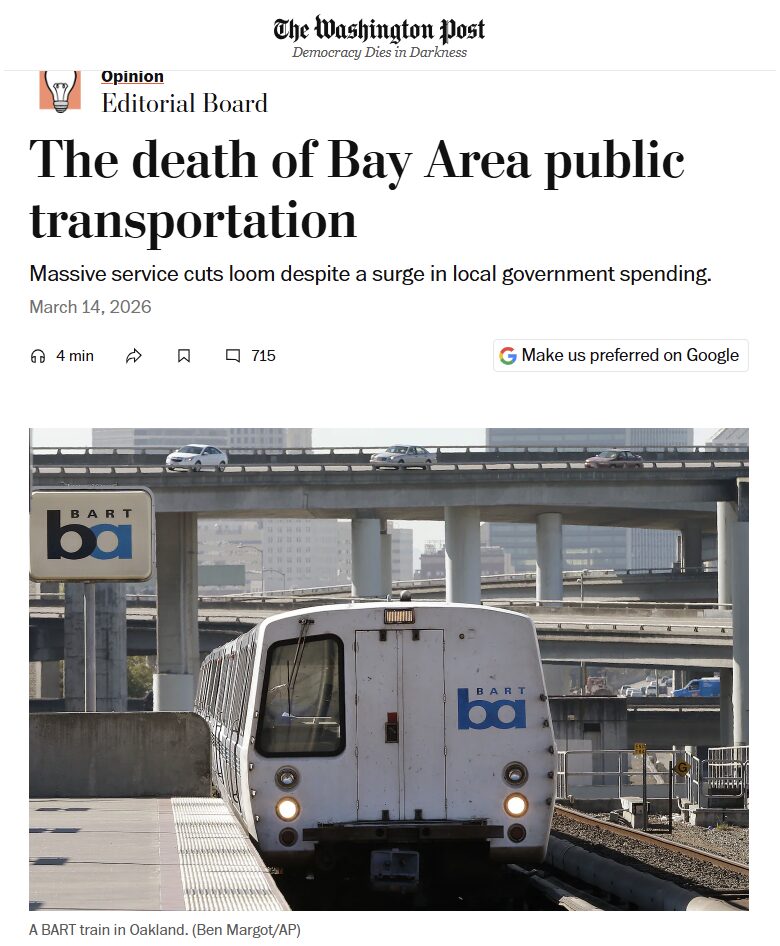
The Washington Post has taken a deep dive into the finances of BART — San Francisco’s Bay Area Rapid Transit and discovered why it’s in a financial hellhole.
The Post found that BART labor costs have risen $150 million since 2019, while ridership dropped by 73 million trips. BART is threatening to make massive service cuts if voters don’t approve a steep tax increase on the November ballot.
The obvious solution is to privatize transit systems.
Another idea is to move toward 21st century automation. Vancouver, Canada and Copenhagen tried it, and the result was a savings of nearly one-half along with service quality improvements.
The Post notes that “Politicians would need to stand up to transit unions, repeal the federal law hindering labor cuts and set aside money for the one-time costs of transitioning to automated service. Maybe when the alternative is closing down transit systems altogether, they’ll see the light.”
By the way, in five years or so, we will have driverless Ubers and Lyfts and we won’t need clunky, mid 20th century transit systems any longer.
As a refresher, our friend Randal O’Toole sent us this helpful chart demonstrating that as costs continue to rise, ridership plummets.
